Why Are Some Fertility Clinics Using Human Growth Hormone (HGH) During IVF
Why Are Some Fertility Clinics Using Human Growth Hormone (HGH) During IVF?
By Jaclyn Iasnik, RN | Destination Conception
If you’ve been researching IVF or scrolling through fertility support groups, you’ve probably seen people talking about Human Growth Hormone (HGH) being added to their IVF protocol.
Some patients swear it made all the difference.
Others wonder why their clinic doesn’t offer it.
So what’s the truth?
Let’s break it down.
What Is Human Growth Hormone?
Human Growth Hormone (HGH), also called somatropin, is a naturally occurring hormone produced by the pituitary gland. It plays an important role in growth, metabolism, and cell repair.
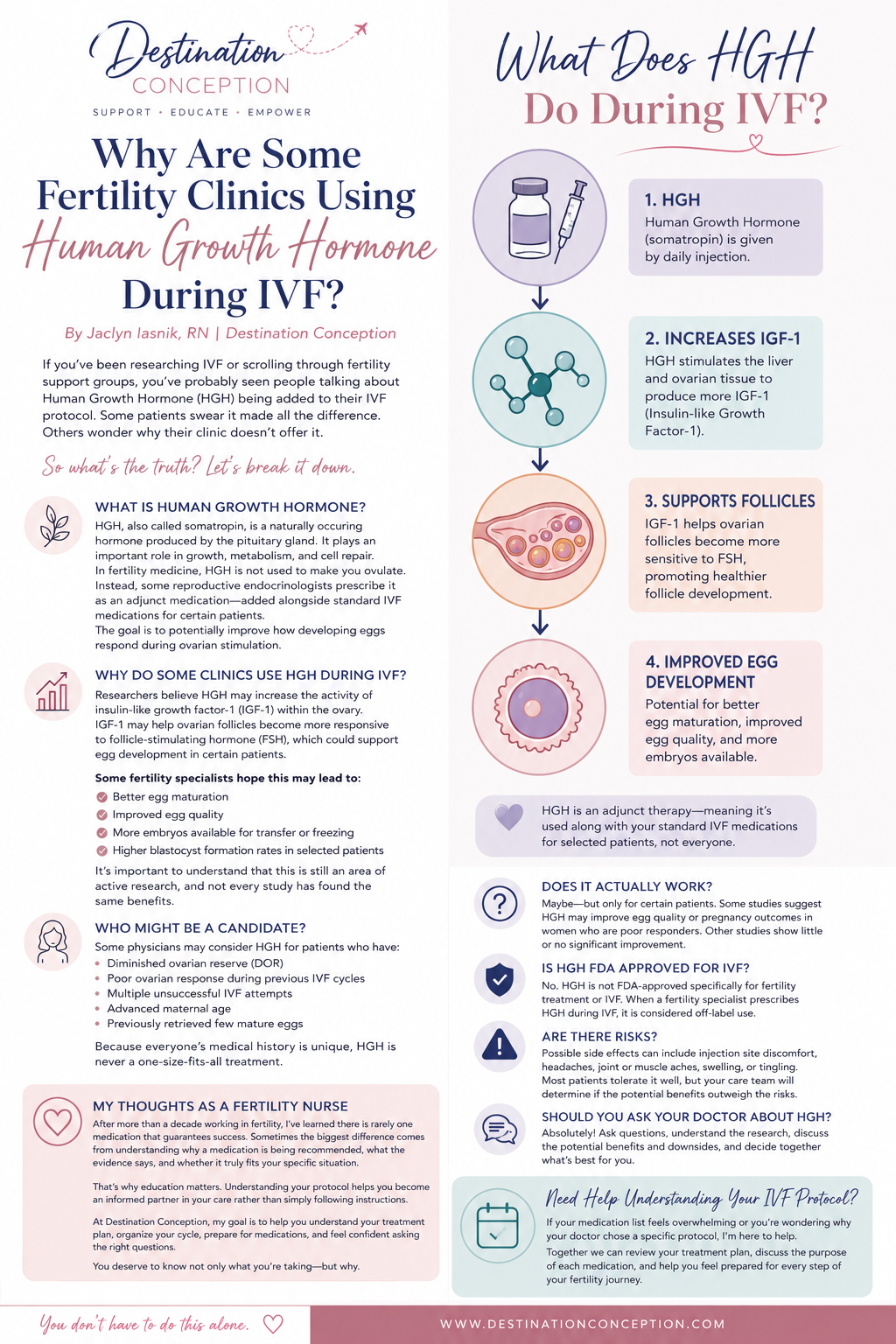
In fertility medicine, HGH is not used to make you ovulate. Instead, some reproductive endocrinologists prescribe it as an adjunct medication—meaning it’s added alongside standard IVF medications for certain patients.
The goal is to potentially improve how developing eggs respond during ovarian stimulation.
Why Do Some Clinics Use HGH During IVF?
Researchers believe HGH may increase the activity of insulin-like growth factor-1 (IGF-1) within the ovary.
IGF-1 may help ovarian follicles become more responsive to follicle-stimulating hormone (FSH), which could support egg development in certain patients.
Some fertility specialists hope this may lead to:
Better egg maturation
Improved egg quality
More embryos available for transfer or freezing
Higher blastocyst formation rates in selected patients
It’s important to understand that this is still an area of active research, and not every study has found the same benefits.
Who Might Be a Candidate?
Every fertility journey is different, but some physicians may consider HGH for patients who have:
Diminished ovarian reserve (DOR)
Poor ovarian response during previous IVF cycles
Multiple unsuccessful IVF attempts
Advanced maternal age
Previously retrieved few mature eggs
Because everyone’s medical history is unique, HGH is never a one-size-fits-all treatment.
Does It Actually Work?
This is probably the biggest question.
The honest answer is:
Maybe—but only for certain patients.
Some studies suggest HGH may improve egg quality or pregnancy outcomes in women who are considered poor responders.
Other studies have shown little or no significant improvement.
Because the evidence is mixed, major fertility organizations have not recommended HGH as a routine part of every IVF cycle.
That’s why you’ll notice that some clinics use it frequently, while others rarely prescribe it.
Is HGH FDA Approved for IVF?
No.
HGH is not FDA-approved specifically for fertility treatment or IVF.
When a fertility specialist prescribes HGH during IVF, it is considered off-label use, which is common in many areas of medicine when physicians believe there may be a benefit for selected patients.
Are There Risks?
Like any medication, HGH has potential side effects.
Some patients experience:
Injection site discomfort
Headaches
Joint or muscle aches
Swelling or fluid retention
Tingling in the hands
Most patients tolerate it well, but your fertility team will determine whether the potential benefits outweigh the risks for your individual situation.
Should You Ask Your Doctor About HGH?
Absolutely.
One of the most important things you can do is have an open conversation with your reproductive endocrinologist.
Questions you might ask include:
Am I considered a poor responder?
Would HGH make sense based on my ovarian reserve?
What does the research show for someone with my diagnosis?
What are the potential downsides?
Is the additional cost likely to provide meaningful benefit?
The right treatment plan should always be personalized—not copied from someone else’s IVF journey.
My Thoughts as a Fertility Nurse
After more than a decade working in fertility, I’ve learned there is rarely one medication that guarantees success.
Sometimes the biggest difference comes from understanding why a medication is being recommended, what the evidence says, and whether it truly fits your specific situation.
I’ve cared for patients who used HGH and had wonderful outcomes, and I’ve cared for others who achieved success without it.
That’s why education matters.
Understanding your protocol helps you become an informed partner in your care rather than simply following instructions.
At Destination Conception, my goal is to help you understand your treatment plan, organize your cycle, prepare for medications, and feel confident asking the right questions.
You deserve to know not only what you’re taking—but why.
Need Help Understanding Your IVF Protocol?
If your medication list feels overwhelming or you’re wondering why your doctor chose a specific protocol, I’m here to help.
Together we can review your treatment plan, discuss the purpose of each medication, and help you feel prepared for every step of your fertility journey.
Because informed patients make empowered decisions.